Work

Jump Back In

Finds the episode you stopped a show at, without telling you what happens next.

PythonJavaScriptCloudflare

The problem

You watched a show a few years ago, got partway in, and stopped. The account was someone else's, or the app forgot, or you never had one. There is no viewing history of you anywhere, which is the whole reason the product exists.

Every obvious way to go find the place spoils it. An episode list is a wall of titles that give away endings. A synopsis tells you the thing you stopped before. Asking a friend who finished it is the worst option of all. So the only record left is your own memory, and the job is to read it without writing to it.

Someone needs this maybe three times a year. They arrive on a phone, on a couch, a few seconds before pressing play, and they will leave the moment the answer is on screen. Nothing about that visit justifies an account, a download, or a minute of setup.

Screens

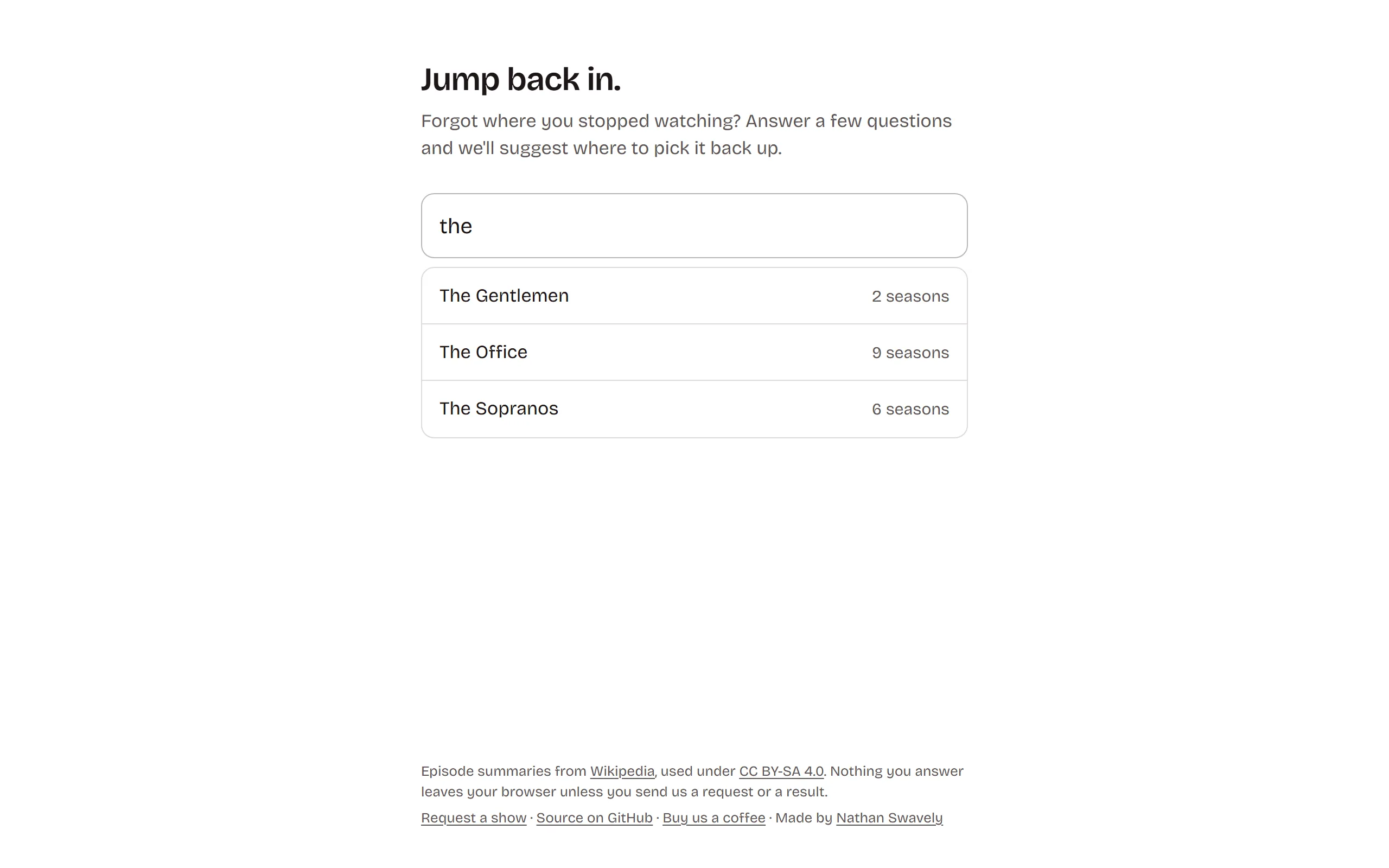
The Jump Back In show search on desktop. A single centered column with a search field and a short list of matching shows beneath it.
The first screen. One column, one field, and the catalog itself as the empty state.
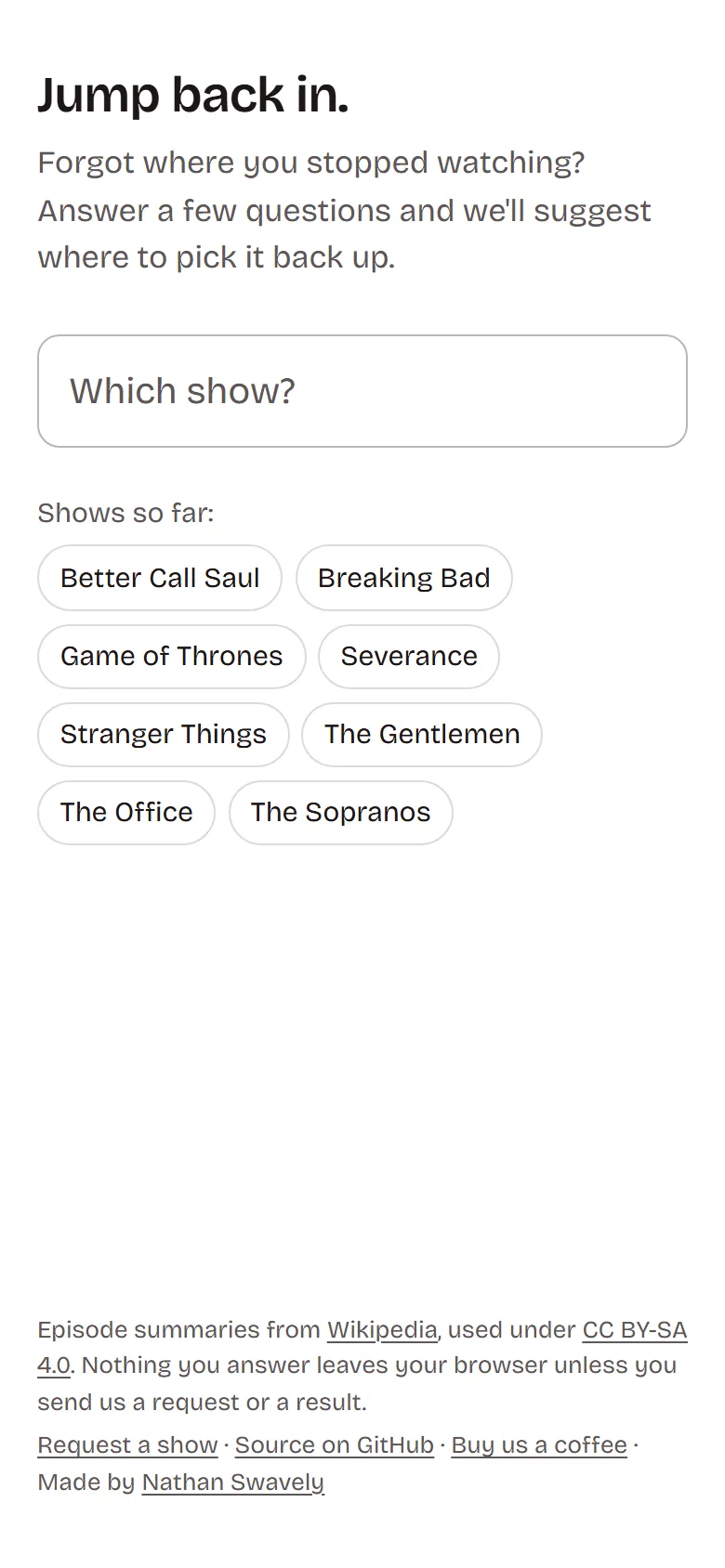
The same search screen on a phone, with the catalog listed as tappable chips below the field.
The same screen on a phone. Nothing reflows, because there was only ever one column.
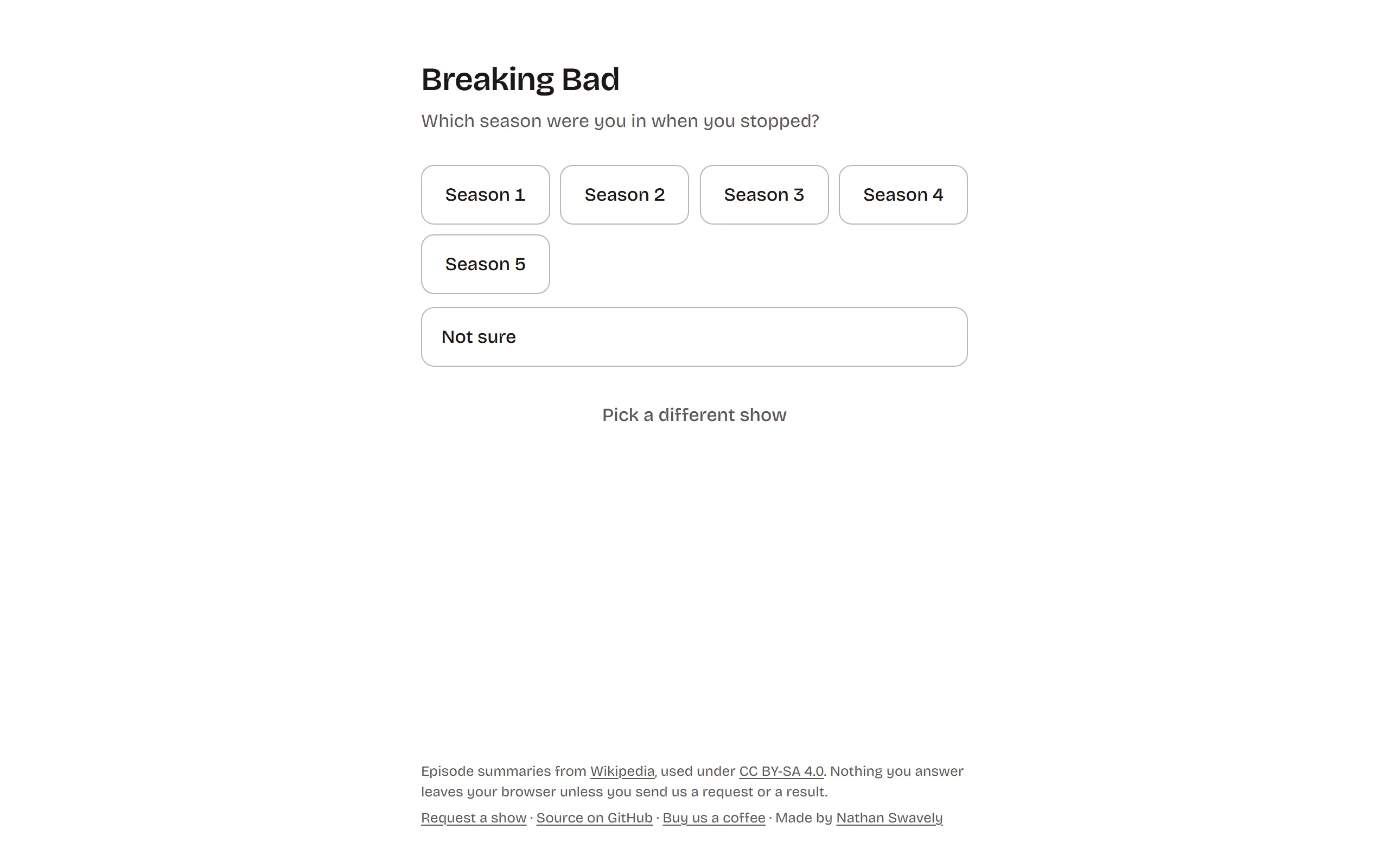
The season picker, showing a wrapping grid of numbered season buttons with a quieter "Not sure" option beneath them.
Seasons, plus the answer most people actually have. "Not sure" starts a shorter walk that finds the season first.
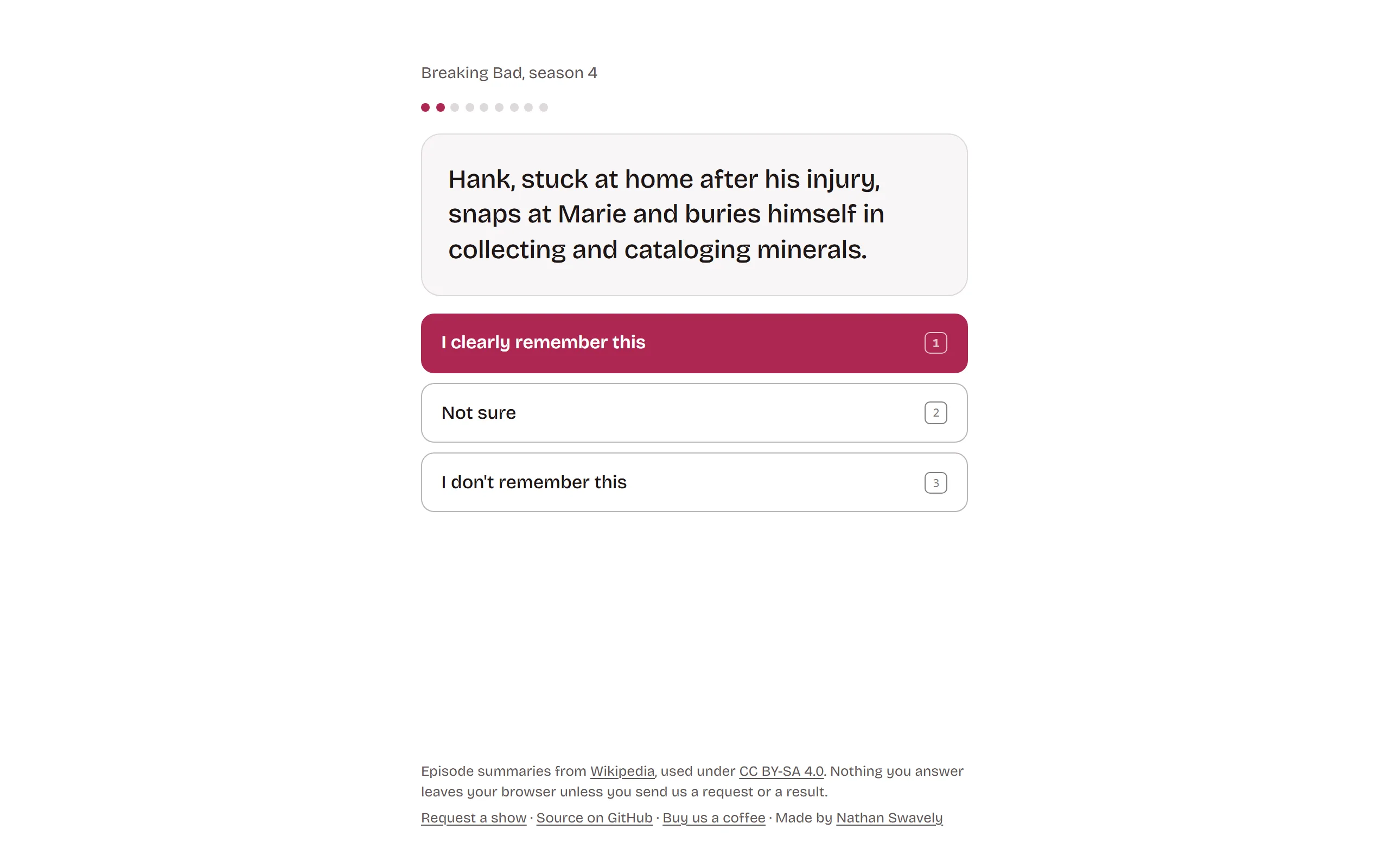
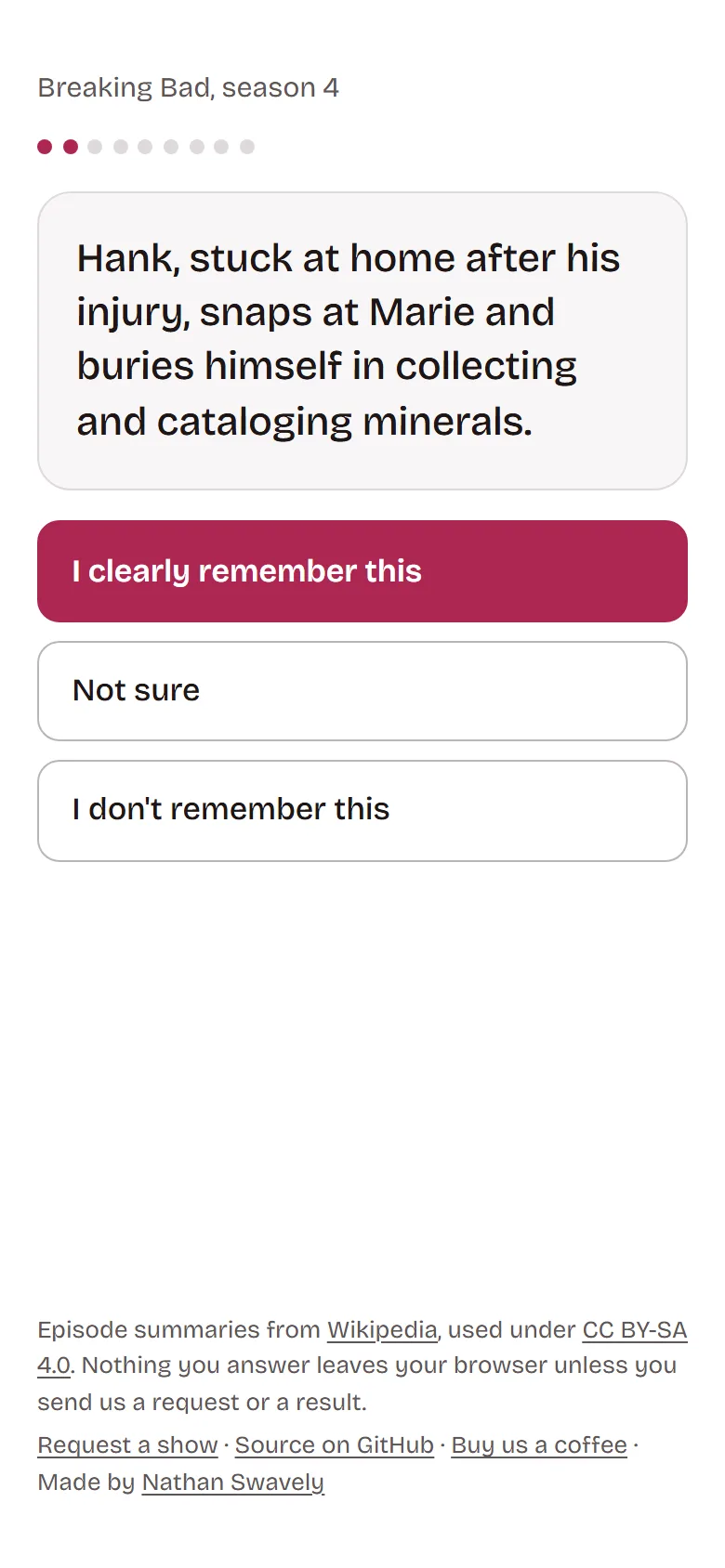
A probe card mid-walk. One sentence describing a small moment from an episode, three answer buttons under it, and a row of progress dots.
The card is the product. One remembered moment, three answers, and dots instead of a count.
The same probe card on a phone. The three answer buttons stack full width beneath the card, without the keyboard shortcut badges the desktop answers carry.
On a phone the answers run full width and drop their keyboard hints. It is used one-handed, on a couch, right before pressing play.
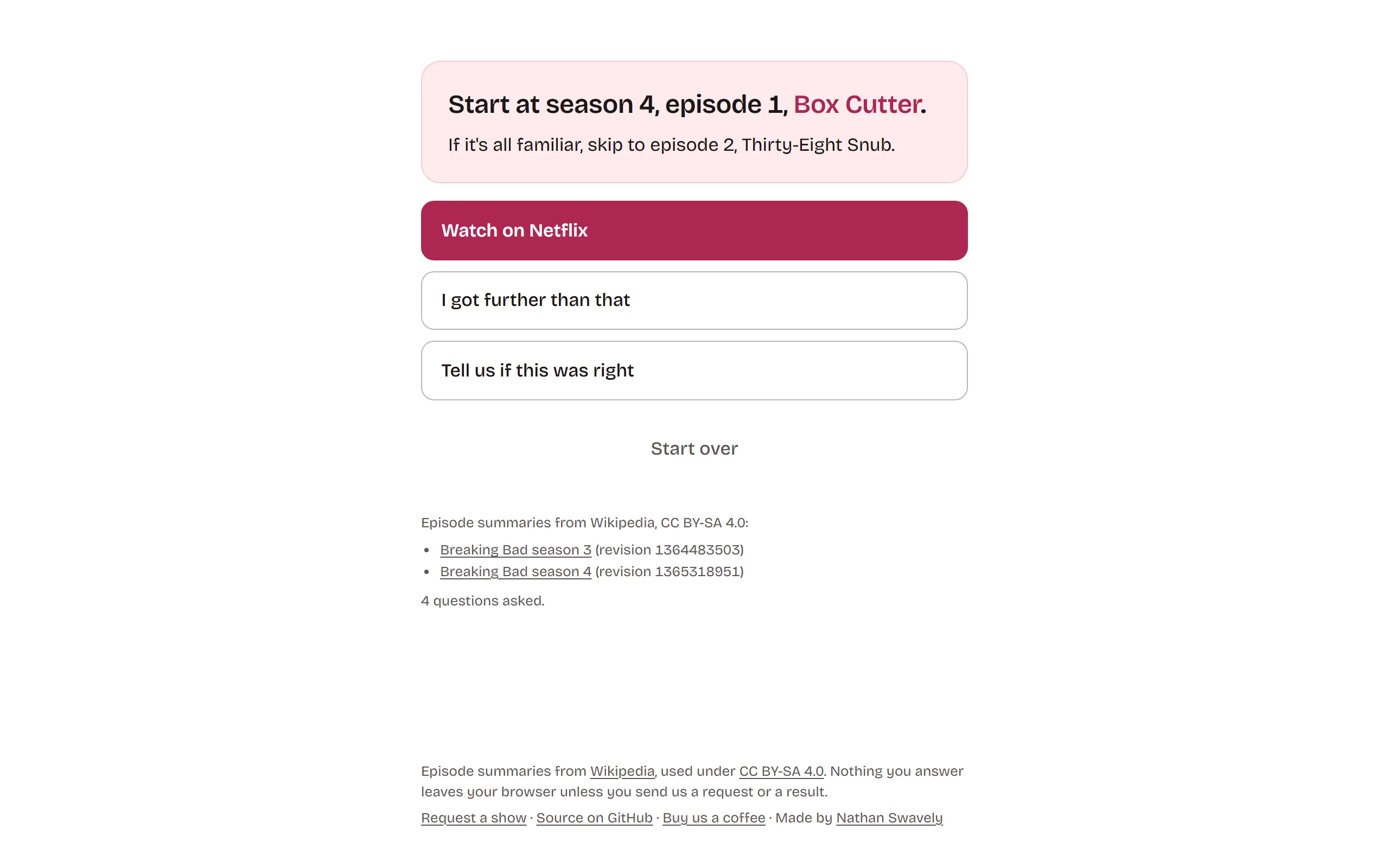
The result screen, naming an episode to start from with a fallback episode beneath it and two links to continue the walk.
The result is advice with a fallback, not a verdict — and it can be argued with.

Design decisions

Walk forward, don't binary search

Finding one episode in thirteen is a search problem, and the textbook answer is to halve the range. Binary search opens at the midpoint, so the very first question describes a moment from several episodes past where you stopped, roughly half the time, before anything at all is known about you. The efficient algorithm spoils the show on question one.

So the walk goes forward from the start of the season instead, two or three episodes at a stride. Every card it shows is from an episode you have already seen, right up until the single card that crosses the line — and that is the episode you are about to watch anyway. Then a second pass fills in the episodes the stride skipped, one at a time, and that pass cannot spoil anything at all: every episode it asks about is either already watched or the next one up.

It costs more questions than binary search, and the bound it buys is structural rather than probabilistic. The most a walk can ever reach past your stopping point is one episode less than the stride. That is a property of the shape, not a number that came out of a test.

Three answers, and only one of them moves forward

Every card offers I clearly remember this, Not sure, and No. The wording is part of the algorithm. Only the first answer advances the walk, and a false yes is the one input that can push a card past your stopping point, so it is written as a high bar on purpose: anything short of certainty should land in "not sure", where it costs nothing but another card.

The card carries no episode number. Numbers invite arithmetic — it's episode four, I think I got past four — and reasoning of that kind manufactures yeses that memory never supplied. Progress is a row of dots for the same reason: a count would tell you how many are left and invite you to finish rather than answer.

Nothing on any screen grades you. No score, no percentage, no correct answer, no reveal. The voice is a friend walking you back through your own memory, interested in what you remember and unbothered by what you don't.

A hazy answer used to strand people seasons early

The first person to use it who genuinely did not know where they stopped chose "not sure" for the season, answered "not sure" to three cards from a premiere, and got an answer two seasons before where they actually were. The walk had treated an all-"not sure" episode as a no, locked in the season before it, and offered no way to argue.

Three things were wrong, and all three were the same mistake: undershooting had been treated as free. It is cheap by one episode and expensive by three seasons. Now an episode you are hazy on is unresolved rather than final; the walk asks once whether to keep going and continues at the stride if you say yes, which is also the moment to ask, because you have just seen what a card looks like. The result screen gained an escape hatch — I think I got further than that — and a season that finishes offers to carry on into the next one.

The result is phrased to match: an episode to start from, a fallback beneath it because people stop mid-episode and rewatching one is cheap, and a plain sentence when the memory went hazy rather than a number pretending it didn't.

The safety check is the expensive model, and it stays that way

Cards are written offline from Wikipedia episode summaries, then audited three ways before anything ships: does the moment actually identify the episode it claims, does it give away an outcome, and does it name anyone you have not met yet. Only survivors are shipped, and the audit assumes you have seen only as far back as the stride, not up to the previous episode — an assumption that was wrong once and leaked the ending of the episode a walk had stepped over.

Writing the cards is the cheap half and a budget model does it well enough, at a few cents a season. Judging them is not. Scored against the same labelled set, the cheap model caught 30% of the genuine spoilers with the shipped prompt and 62% with sixteen worked examples, where the bar was 90%. It could reliably find the sentence that gave the game away; it just did not think that it mattered. At about a dollar a season, the audit is the cheapest part of this product to get right, so it stays on the model that gets it right.

One card, one voice, one thing with color

Pure white or near-black, no tint, one typeface, and a single deep red that marks the one thing you can do next — used at most once as a fill per screen. The card holds the largest text anywhere on the site and everything else steps back from it. There is no imagery at all, which started as a licensing consequence and turned out to be the right call: the corpus is Wikipedia-only, so there is no poster art to use, and a poster wall would have made it look like the app you watch on rather than the thing you open right before.

Everything works from the keyboard — 1/2/3 or y/u/n — and on a phone the answers sit in the lower half of the screen, within reach of a thumb, because one-handed on a couch is the only posture this is ever used in. Light and dark both follow the system and both are first class. The footer says on every screen that nothing you answer leaves the browser, which is true, and is the kind of claim that is only worth anything where someone can read it.

What it runs on

The site is plain HTML and JavaScript on Cloudflare Workers, with the whole corpus shipped as static JSON. No backend, no accounts, no analytics of your answers — the walk runs entirely in the page, which is why the privacy claim in the footer needs no trust. A Python pipeline does the expensive work offline: fetch summaries, write candidate moments, audit them, build the site data.

Every season is verified by simulation before it ships. A harness plays a viewer with a known stopping point at every possible stopping point in the season, and the season is only shippable if all of them resolve to the right episode and no card reaches further past it than the stride allows. Summaries come from Wikipedia under CC BY-SA 4.0, attributed per episode.

Shows
8
Seasons
43
Episodes
547
Probes
1,233

Shipped today. The catalog grows one show at a time, by request.